
The Function and Importance of Capacitor Banks in Power Substations
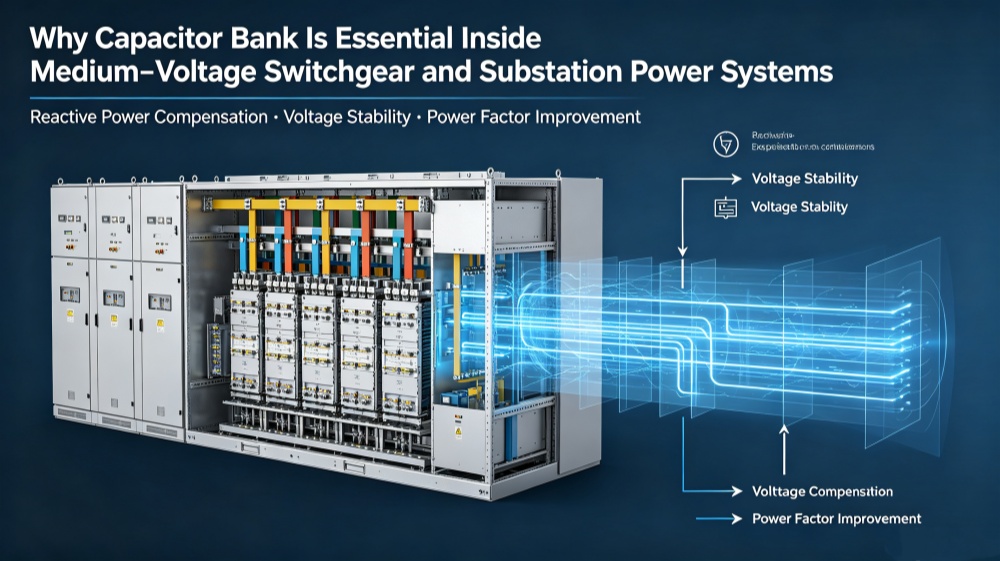
In modern power transmission and distribution systems, power substations serve as the core hub for voltage conversion, power distribution, and grid operation regulation. The stable, efficient, and economical operation of substations directly determines the overall power supply quality of the entire power grid. In actual grid operation, a large number of inductive loads—including industrial motors, power transformers, inductive reactors, and power transmission lines—consume massive reactive power during operation. Excessive reactive power demand will trigger a series of grid problems such as low power factor, line power loss, voltage drop, and grid capacity waste. To solve these industry pain points, capacitor banks have become indispensable core reactive power compensation equipment in power substations. Composed of multiple capacitors connected in series or parallel combinations, capacitor banks are professionally applied forreactive power compensation and power factor correction, laying a solid foundation for high-efficiency, stable, and low-consumption operation of power systems.
The primary and most critical application value of capacitor banks is to improve overall power supply quality and operational efficiency of the power grid. When inductive loads dominate the power system, the current lags behind the voltage, generating a large amount of lagging reactive power. This unbalanced power state will not only increase the active power loss of transmission lines and substation equipment but also cause obvious voltage drop at the load end, resulting in unstable power supply voltage. In addition, uncompensated reactive power will exacerbate grid harmonic distortion in complex operating scenarios, interfering with the normal operation of precision electrical equipment. By injecting capacitive reactive power into the power grid, capacitor banks effectively counteract the lagging reactive power generated by inductive loads, balance the grid power phase relationship, significantly reduce line transmission losses and voltage drop phenomena, and suppress harmonic fluctuations. This precise compensation mode optimizes the power waveform of the grid, greatly improving the accuracy, stability, and consistency of power supply quality for industrial production, commercial power consumption, and residential electricity scenarios.
Secondly, capacitor banks effectively enhance the effective capacity of power transmission and distribution systems and optimize grid resource utilization. The power transmission capacity of substation transformers and overhead cables is limited by the total apparent power of the system. Apparent power consists of active power and reactive power. When the system has a high reactive power proportion, a large amount of grid capacity is occupied by invalid reactive power transmission, which seriously restricts the access of new electrical loads. In this case, even if the active power demand of the system is not saturated, the grid will face overload risks due to excessive reactive power circulation. After installing capacitor banks for reactive power compensation, the reactive power circulation in the grid is greatly reduced, freeing up the limited apparent power capacity of transformers and cables. This enables the power system to carry more active power loads without equipment overload or line congestion, effectively improving the utilization rate of existing power grid equipment, expanding the actual power supply capacity of substations, and avoiding repeated investment and construction of power infrastructure caused by capacity waste.
From the perspective of power operation economy, capacitor banks significantly reduce enterprise and grid operational costs by optimizing power factor and avoiding grid penalty fees. Power grid management departments worldwide formulate strict power factor assessment standards for industrial and large-scale power users. When the user’s power factor is lower than the specified standard value, it indicates poor power quality and low grid operation efficiency, and the power user will be charged additional reactive power penalty fees. Long-term low power factor operation will bring continuous economic losses to enterprises. Capacitor banks can dynamically adjust the reactive power output according to real-time grid load changes, maintain the system power factor within the optimal standard range, completely eliminate the penalty cost caused by insufficient power factor, and reduce the comprehensive electricity cost of power users. Meanwhile, the reduction of line and equipment power losses also lowers the energy consumption cost of power grid operation, bringing significant long-term economic benefits for both power supply enterprises and power consumers.
In terms of grid operation safety and stability, capacitor banks play a vital role in voltage regulation and grid risk prevention. Long-distance power transmission and fluctuating load changes are prone to grid voltage deviation and voltage instability problems. In extreme operating conditions, continuous reactive power shortage will trigger severe voltage drop, and even lead to voltage collapse, causing large-scale power outages and major grid safety accidents. Capacitor banks have excellent dynamic voltage support capability: when the grid load increases and the system voltage drops, the capacitor bank outputs reactive power to boost the grid voltage; when the load decreases and the voltage rises, the compensation capacity can be adjusted accordingly to stabilize the voltage level. This real-time voltage regulation function effectively suppresses grid voltage fluctuation, eliminates the risk of voltage collapse, and greatly improves the overall reliability, safety, and anti-interference ability of the power system. In addition, reasonable reactive power compensation can avoid equipment overheating and abnormal overvoltage faults caused by long-term excessive reactive power circulation, effectively protecting core equipment such as transformers, switches, and transmission lines, extending the service life of power equipment, and reducing equipment failure rate and maintenance costs.
According to different grid compensation requirements, capacitor banks are divided into two mainstream connection modes: parallel capacitor banks and series capacitor banks, which are installed in key positions such as substations and feeder lines to achieve targeted optimal compensation. Parallel capacitor banks are the most widely used compensation equipment in power substations. They are connected in parallel with grid loads and power supply lines, and their core function is to offset the lagging reactive power generated by inductive loads such as motors and transformers. They are suitable for conventional reactive power compensation and power factor correction of distribution networks and industrial power systems, with flexible adjustment and wide applicability.
Series capacitor banks are connected in series with long-distance transmission lines, mainly used for ultra-high voltage and long-distance power transmission scenarios. Their core principle is to compensate the inductive impedance of transmission lines, reduce line power transmission impedance, weaken line voltage loss and power oscillation, and significantly improve the transmission efficiency and maximum transmission capacity of long-distance lines. While optimizing line transmission performance, series capacitor banks also enhance the static and dynamic stability of long-distance power transmission systems, ensuring safe and efficient power delivery across regions.
In conclusion, capacitor banks are essential reactive power compensation devices in power substation systems, with comprehensive advantages in improving power supply quality, expanding grid capacity, reducing operating costs, ensuring grid stability, and protecting power equipment. With the continuous development of smart grids and the increasing complexity of power load structures, the application of intelligent and adjustable capacitor banks has become more extensive. They not only solve various operational problems caused by reactive power imbalance in traditional power grids but also provide strong technical support for the efficient, economical, safe, and stable operation of modern power systems, which is an indispensable key link in power grid operation and maintenance.